
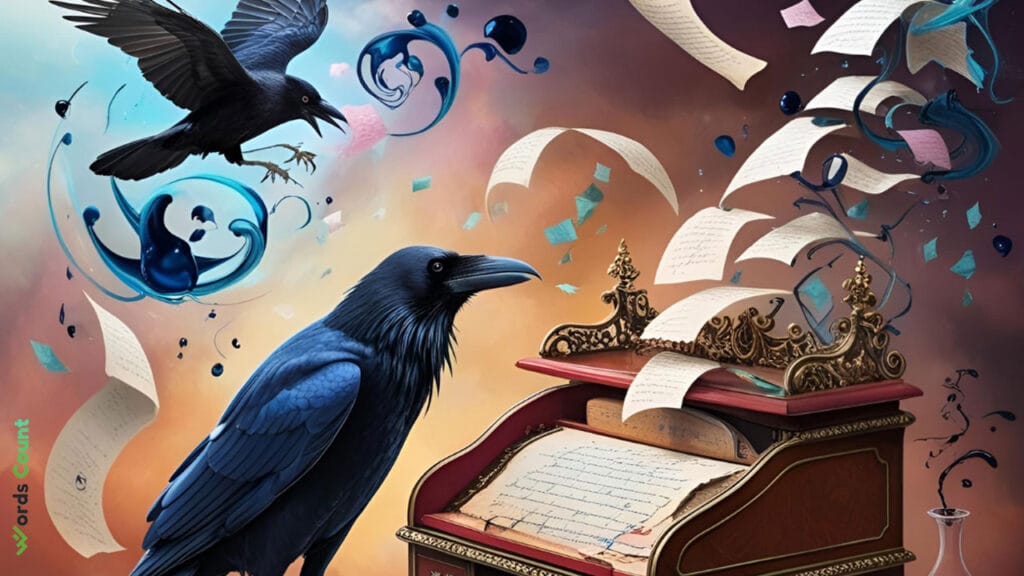
A raven is like a writing desk because both can produce a few notes, though they are typically very flat. This riddle, famously posed by Lewis Carroll in Alice’s Adventures in Wonderland, has intrigued readers for generations, blending humor, mystery, and creativity.
The famous riddle “Why is a raven like a writing desk?” posed by Edgar Allan Poe in his literary masterpiece The Raven has intrigued readers for generations. Its enigmatic nature, combined with its unorthodox structure, has led to endless speculation, analysis, and even amusement. In this article, we will dive deep into the historical context of this question, explore the literary elements that make it significant, and examine various interpretations to uncover why, after all, a raven might indeed be like a writing desk.
The Origins of the Riddle
Edgar Allan Poe and The Raven
Edgar Allan Poe, one of America’s most renowned poets and writers, is perhaps best known for his dark and gothic literary works. The Raven, published in 1845, became one of his most famous poems, largely due to its haunting atmosphere and rhythm. The poem introduces a mysterious raven that speaks the word “Nevermore,” and this word takes on a symbolic meaning throughout the narrative.
The line “Why is a raven like a writing desk?” appears in the poem itself during the interaction between Poe’s narrator and the raven. However, despite the riddle being central to the poem’s intrigue, Poe never provided an answer. This deliberate lack of resolution prompted many readers and scholars to come up with their own answers, furthering the mystery and increasing the poem’s allure.
The Riddle’s Role in the Poem
The riddle can be viewed as a playful element within a work brimming with melancholic undertones. The darkness and despair of the poem’s themes are contrasted by this seemingly light-hearted puzzle, creating an odd juxtaposition. Poe’s choice to leave the riddle unanswered speaks to the broader themes of uncertainty and the unknowable, mirroring the grief-stricken narrator’s own quest for answers in the face of loss.
Symbolism Behind the Raven
The Raven as a Symbol of Mystery
The raven itself is a powerful symbol, often associated with mystery, death, and omens in various cultures and mythologies. In Norse mythology, for instance, ravens are connected to the god Odin, often seen as carriers of wisdom and secrets. And In Western cultures, ravens are often linked with death and the supernatural, thanks in part to their dark feathers and scavenger behavior.
In The Raven, the bird represents the narrator’s descent into madness and his inability to escape his sorrow. The bird’s repeated utterance of “Nevermore” serves as a cruel reminder of the narrator’s inability to find solace or closure. Thus, the raven itself becomes a symbol not just of mystery but of inescapable reality—a reality the narrator cannot outwit, despite his desperate inquiries.
The Raven as a Metaphor for Writing
Writing, much like the raven, has the ability to haunt and perplex. Words can be both beautiful and sinister, capable of conveying emotion, ideas, and meaning that can be understood or misunderstood. In this way, the raven’s repetitive cry, “Nevermore,” can be seen as symbolic of the cyclical nature of writing—how an author might endlessly search for meaning, only to find that they are trapped in a loop of their own creation.
Symbolism Behind the Writing Desk
The Writing Desk: A Symbol of Creation
A writing desk is, of course, a central tool for any writer. It represents the act of creation, of putting thoughts into words. A desk is where writers do their work, sitting and composing, crafting narratives, and bringing to life their own interpretations of the world around them. Much like the raven, the writing desk can be a site of both inspiration and frustration. Writers can experience intense emotional highs when their thoughts flow easily onto paper and crushing lows when they struggle to express their ideas.
The writing desk can also be seen as symbolic of the mental and emotional labor required to create meaning. Writers often pour their deepest emotions, thoughts, and experiences into their work, and like the raven, their creations can take on lives of their own, becoming independent from the creator’s initial intentions. This connection between the raven and the desk further reinforces the idea that both serve as tools for creation, albeit in different forms.
The Desk as a Site of Reflection
Beyond being a place of physical writing, the desk also represents a space for reflection and contemplation. Writers often sit at their desks, pondering life’s great mysteries, just as Poe’s narrator reflects on his own inner turmoil. The desk is a silent witness to these moments of introspection, much like the raven, which silently observes the narrator’s suffering in The Raven. Both are objects of contemplation, carriers of thought, and perhaps even agents of revelation.
The Mystery of the Riddle
The Absence of an Answer
When Poe introduced the riddle “Why is a raven like a writing desk?” he did not provide an immediate answer. This deliberate omission adds another layer to the poem’s overall atmosphere of mystery and uncertainty. Readers are forced to wrestle with the question themselves, which enhances the riddle’s power. The absence of a clear solution invites endless interpretations and possibilities, making the riddle an intellectual puzzle as well as a literary device.
In the absence of an official answer, several scholars and readers have proposed their own theories. Some believe the riddle is a clever commentary on the process of writing itself. Others interpret it as a metaphor for the relationship between creativity and the unknown. Yet, there is no universally accepted solution, which is part of what makes the riddle so compelling.
The Riddle as a Representation of the Unanswerable
The riddle’s ambiguity is symbolic of the larger themes of the poem. The narrator’s search for answers—whether it is an answer to his grief, to the mysteries of life, or to the nature of the raven itself—is ultimately fruitless. Like the riddle, these questions remain unanswered. This inability to find closure mirrors the eternal tension between the living and the dead, the known and the unknown, and perhaps even between the writer and their own creations.
Possible Answers to the Riddle
Over time, readers and literary scholars have proposed a variety of answers to the question of why a raven is like a writing desk. Some of these answers focus on the physical qualities of the raven and the desk, while others delve into more symbolic interpretations.
1. Both are associated with darkness or melancholy.
Both the raven and the writing desk can be linked to darker themes. The raven is often a harbinger of death, while a writer, especially one like Poe, frequently delves into melancholic or morbid subjects. The desk, much like the raven, can be seen as a place of contemplation over somber themes.
2. Both serve as instruments of communication.
Ravens can communicate through their calls, and writing desks are where writers communicate their thoughts through the written word. Both serve as vehicles for expressing ideas and emotions.
3. Both are creatures of habit.
A raven, like a writer, often repeats itself. The raven’s call of “Nevermore” serves as a constant refrain in the poem, and writers often find themselves repeating certain motifs, themes, or patterns in their work. This cyclical repetition connects both the raven and the writing desk as tools of persistent creation.
4. Both evoke mystery and the unknown.
Ravens are creatures that are often associated with the supernatural or the mysterious, while a writer’s desk is a place where new ideas and imaginative worlds are created—places that may be mysterious or unknown to readers. Both are tied to the idea of uncovering the unknown.
5. Both are symbols of transformation.
The raven undergoes a transformation in Poe’s poem, going from an innocent bird to a symbol of doom and despair. Likewise, the writing desk is where raw thoughts undergo transformation into words that carry emotional weight and meaning. This shared theme of transformation links the two objects.
The Legacy of the Riddle
Since its inception in The Raven, the riddle has become one of the most enduring elements of Poe’s literary legacy. It has been analyzed, interpreted, and reinterpreted in numerous forms. The ambiguity of the riddle has allowed it to transcend its original context, becoming a symbol of the unknown and the mysterious in literature.
The Influence on Popular Culture
The riddle has also made its way into popular culture, referenced in books, movies, and even everyday conversations. Its open-ended nature makes it a fun and thought-provoking puzzle that continues to captivate audiences. Whether people are familiar with Poe’s work or not, the riddle often evokes curiosity and contemplation.
Conclusion
In the end, the question “Why is a raven like a writing desk?” serves not only as a playful riddle but also as a powerful metaphor for the themes of mystery, creation, and the unknowable that permeate Edgar Allan Poe’s work. Whether one interprets the riddle as a commentary on the act of writing, a reflection of the narrator’s state of mind, or a symbol of the cyclical nature of life and death, its enduring appeal lies in its ability to provoke thought and encourage exploration.
Frequently Asked Questions
1. Why did Poe leave the riddle unanswered?
Poe left the riddle unanswered to enhance the mystery and intrigue surrounding it, encouraging readers to engage with the puzzle and come up with their own interpretations.
2. Is the raven in The Raven a real bird?
While the raven is a real bird, its role in the poem is symbolic. It represents grief, loss, and the unanswerable questions of life.
3. What does the word “Nevermore” symbolize?
“Nevermore” symbolizes the narrator’s despair and the finality of death. It echoes the narrator’s inability to escape his sorrow and loss.
4. How does the riddle relate to writing?
The riddle connects to writing through the act of communication, creation, and the exploration of deeper themes such as mystery and the unknown.
5. What are other interpretations of the riddle?
Some interpretations suggest that both the raven and the writing desk symbolize transformation, creativity, or even the endless nature of questions and answers.